



Temporary Rust Protection: Salt-Spray Hours Are Not a Storage-Life Guarantee
Read salt-spray evidence without turning hours into storage years. Check the specimen, film, acceptance basis and actual part-and-package arrangement.
On this page
A quotation for rust preventive oil can place several attractive numbers next to each other: a salt-spray exposure, a humidity-test duration and a promised storage period. They are not three versions of the same measurement. A buyer cannot convert laboratory hours into warehouse months simply because all three concern corrosion.
The useful question is narrower: what evidence supports protection of the actual part, with the proposed application and packaging, until the agreed inspection point? This guide separates controlled laboratory exposure from qualification of a storage arrangement. It does not endorse an oil grade, reproduce a test procedure or verify a MOS storage-life claim.
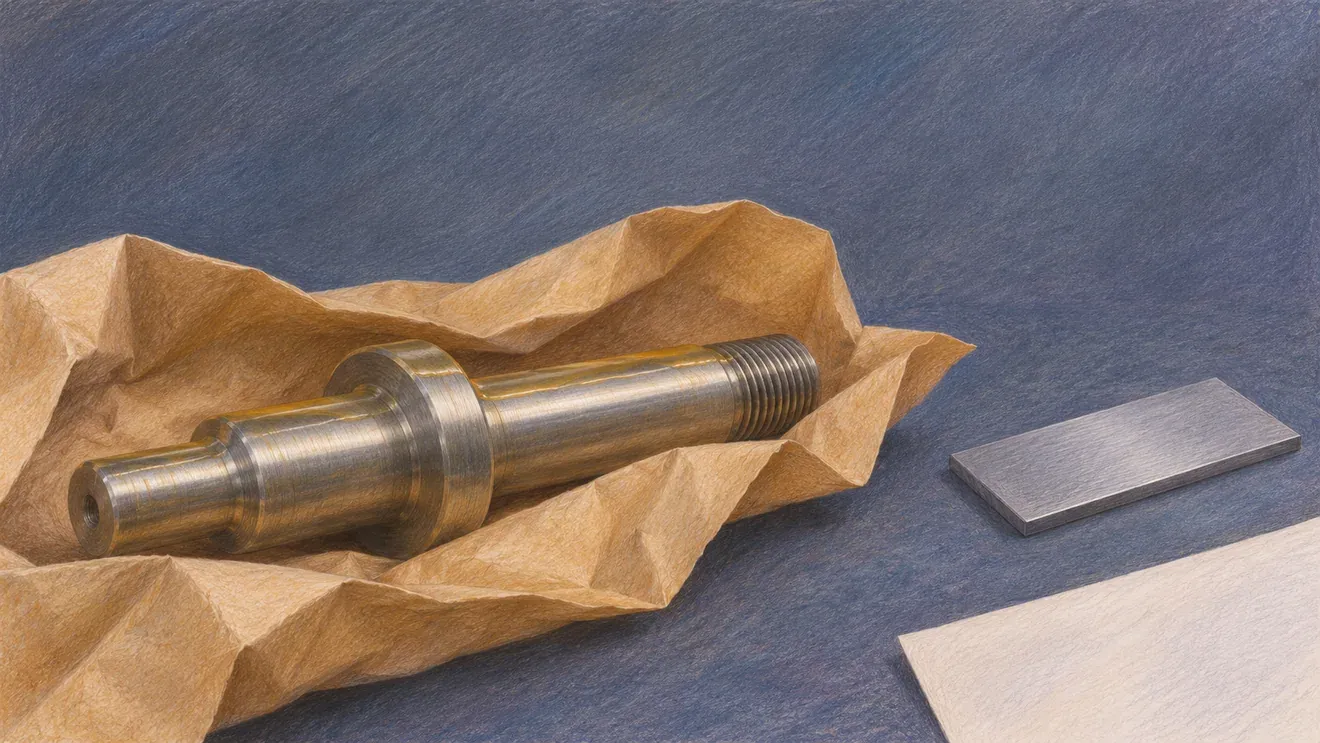
The cover is an original conceptual illustration of a part and a specimen. It is not a photograph of a MOS sample, a corrosion result or an approved packaging design.
Establish what the exposure report can answer
Salt-spray testing exposes prepared specimens to a controlled laboratory environment. Its value depends on the question and agreed acceptance basis. A report can document what happened to the identified specimens during that exposure. It does not, by itself, establish the elapsed time before a packed production part will corrode in a particular supply chain.
Sherwin-Williams discusses the limits and variability of ASTM B117 testing in a coatings context. Q-Lab's corrosion-testing discussion also explains why constant fog differs from more varied exposures. These are useful cautions about interpretation, not measurements of a temporary protective oil or instructions to choose one alternative test for every application.
The official public scope of ISO 9227:2022 includes materials with temporary corrosion protection. It leaves such matters as product exposure periods and interpretation to the relevant product specifications. A reference to the standard therefore does not supply a universal pass duration for rust preventive oils. This article uses the public scope, not access to the complete standard.
Ask the laboratory and supplier to identify the applicable method and edition. Do not treat the standard number as a substitute for the report, the agreed endpoint or a product-specific requirement.
Put competing results on the same basis
This is a document-consistency check against an agreed product requirement, not permission to rank different oils by ISO 9227 hours. Its public scope cautions against ranking the relative corrosion resistance of different materials or predicting long-term resistance. Cross-laboratory reports need their conditions and applicability checked before any interpretation.
Start with the specimen rather than the largest number. Steel grade, surface condition and preparation are part of the evidence. A result on a flat coupon is not automatically a result for a threaded part, a recess or an assembly with retained process residue.
Next identify what was applied. Record the actual oil grade and batch, application method and the film condition when exposure began. A product concentration or a nominal wet application does not, on its own, document the final protective film. Avoid comparing a drained or conditioned film with another report whose preparation is unknown.
| Comparison item | Evidence to retain | What remains unproved without it |
|---|---|---|
| Specimen and surface | Material, geometry, preparation and any relevant prior treatment | That two results concern equally vulnerable surfaces |
| Applied protection | Grade, batch, application and documented film condition | That a difference comes from the oil rather than preparation |
| Exposure and evaluation | Method and edition; specified variant where applicable (NSS, AASS or CASS); laboratory/chamber or run identity, key conditions, duration, interruptions and agreed endpoint | That the reported hours describe the same test question |
| Replication and controls | Number of specimens, individual outcomes and relevant controls | That one selected photograph represents repeatable behaviour |
| Storage arrangement | Actual part, handling, package, environment and inspection point | That a specimen exposure predicts the proposed delivery or storage commitment |
This is a procurement comparison checklist, not an additional ISO or ASTM procedure. The laboratory must define the test under the agreed specification. A report stating only “passed” or showing one clean photograph is incomplete for comparing offers unless the underlying basis is available.
Qualify the protected part and its packaging together
Separate screening from application qualification. An agreed test can assess compliance with its specified acceptance requirement. Screening replacement systems needs a justified application evaluation; salt-spray duration alone does not supply a relative performance ranking. A subsequent qualification should address the intended part and storage arrangement, with inspection and acceptance agreed in advance. Changing the package, handling sequence or application after qualification changes the arrangement that was evaluated.
Map the actual route: cleaning, drying, oil application, any conditioning, packing, transport, receipt, opening and later use. Identify where handling might remove a film or where moisture or contamination might be introduced. These are questions for the responsible process and packaging specialists; they are not proof that a particular paper, bag or oil solves the problem.
Inspect the features that matter to the component rather than only the easiest visible flat area. Define how inaccessible areas will be assessed, what constitutes an unacceptable condition and who records the result. Preserve the package and part identities in the qualification record so that a later failure can be investigated against the same arrangement.
A more complicated accelerated test is not automatically a better acceptance test. Choose the method for the intended failure question and obtain agreement on its interpretation. Do not invent a generic salt-spray-to-calendar conversion or assume that adding a dry stage makes a result predictive of every warehouse.
Read a storage commitment as a conditional specification
A phrase such as “long-term protection” is incomplete until its scope is stated. Ask whether the commitment covers indoor storage, a defined shipment or another environment; whether it starts at application or packing; and whether opening, handling or repacking ends the stated protection condition.
Keep four records separate: the product's technical specification, the batch document, the laboratory report and the qualified part-and-package arrangement. Each may answer a different question. A batch certificate listing an agreed property does not automatically document the full application trial, and a development trial does not prove that every later batch was tested in the same way.
Use a commercial storage period only with its documented conditions, acceptance criteria and responsibility for maintaining them. If those conditions are missing, record the uncertainty before accepting the commitment. Missing information does not prove that an oil fails; it means the proposed use has not yet been established by the evidence supplied.
Make the technical enquiry specific enough to answer
Send the supplier the part material and critical features, current cleaning and application process, intended package, handling route, storage conditions and required inspection point. Add downstream requirements: whether protection must be removed, the intended removal process and any subsequent coating, bonding or assembly operation. Compatibility with that operation needs its own assessment, not an inference from a clean corrosion specimen.
Request the current grade document and an example report with its method, specimen preparation and acceptance basis. Ask which results are typical development data, contractual limits or actual batch results. Agree what must be confirmed on your application before treating the offer as a replacement for an accepted protection system.
MOSLUBE lists a thin-film rust preventive oil. That page is an enquiry entry, not evidence that its listed test or storage values have been independently verified by this guide. Use the actual application details to request the supporting documents. Keep an unconfirmed duration unconfirmed rather than translating it into a delivery guarantee.
For related industrial-fluid interpretation, continue to the technical knowledge section.
References
The limitations of ASTM B117 salt spray (fog) testing — Sherwin-Williams