



EV Coolant Conductivity: Keep Dilution and Acceptance Conditions Together
Compare EV coolant conductivity on the stated dilution, water and temperature. Keep electrical, freezing and corrosion acceptance separate.
A conductivity figure is useful only when it stays attached to the fluid preparation and measurement conditions. For a low conductivity coolant concentrate, the number is not a property that can be carried unchanged into every working dilution. It is also not a complete approval for an EV cooling circuit.
The MOS EV concentrate reference makes the distinction concrete: its supplied COA reports conductivity at 40% by volume, while a separate freezing-point result uses 50%. Those entries answer different questions. Before comparing an offered sample, establish which mixture the equipment requires and which evidence must support its acceptance.
Keep the preparation with the conductivity result
Identify the actual grade and sample first. Record how the working mixture was prepared: concentrate proportion and reporting basis, dilution-water identity and relevant analysis, mixing procedure, and whether the sample is fresh or has undergone a stated exposure. A bare percentage does not tell the reader whether the preparation is by mass or volume. Do not reconstruct a missing preparation from the next row of a report.
Then retain the measurement temperature and procedure with the result. Ask whether a reported value is measured at that temperature or temperature-compensated, and what settings or method support the comparison. Arteco's technical explanation identifies temperature, dilution and ionic composition as relevant variables. Its own product examples are not specifications for MOS material.
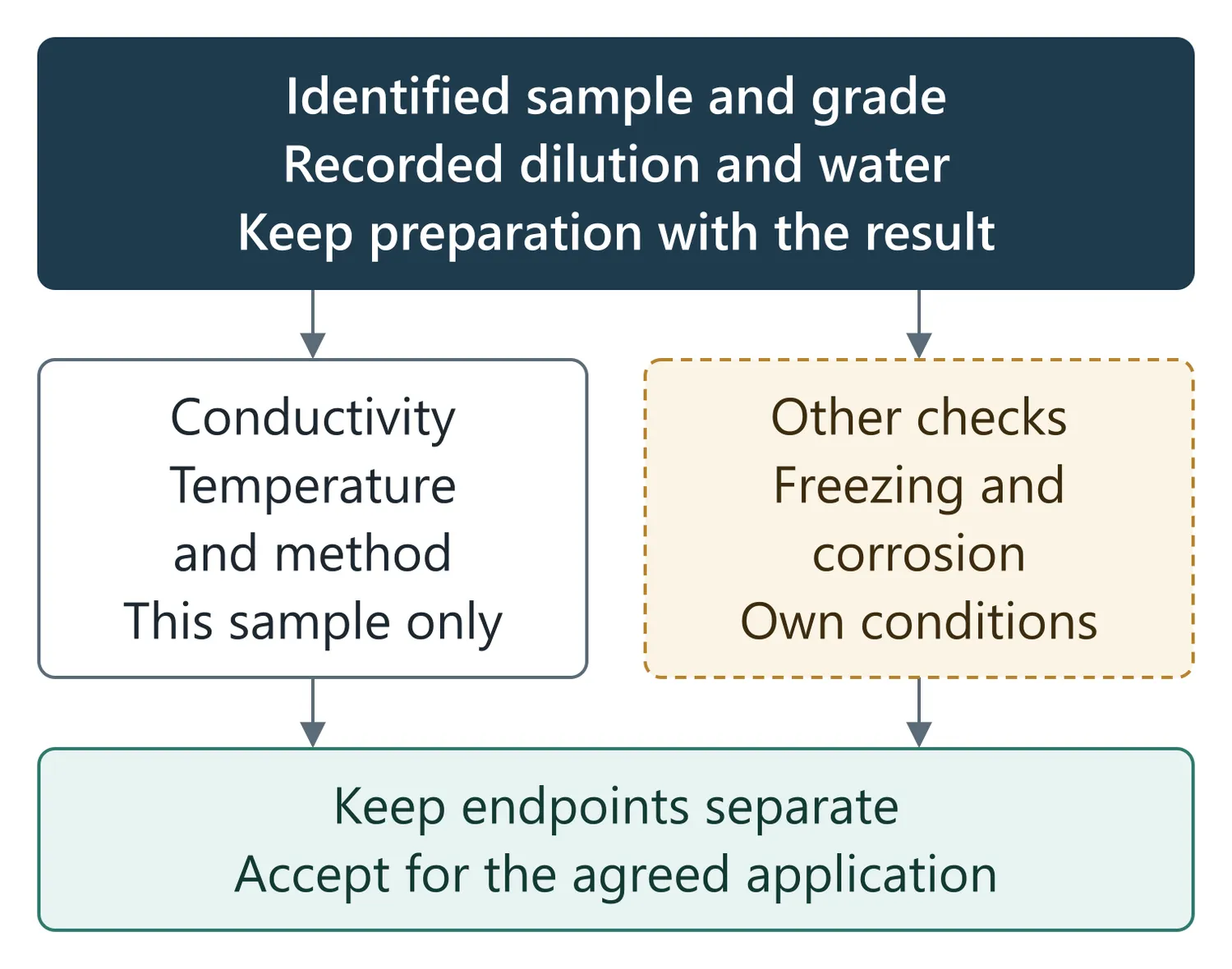
For a controlled purchasing comparison, use the supplier-supported preparation for each candidate and an agreed measurement procedure. If the application requires a common working concentration, compare candidates at that concentration rather than ranking unmatched TDS entries. If their approved preparations differ, disclose the difference and assess each against the actual duty. Do not apply a borrowed linear dilution or temperature correction to manufacture comparable results.
Keep the intended dilution water in the trial. A measurement made with one water source does not establish what a different production-water mixture will do. These are proposed comparison controls, not a substitute for the grade's handling instructions or a prescribed universal test method.
Read the reference COA without combining different tests
The MOS EV Coolant Concentrate Product reproduces supplied-COA sample results. The following entries illustrate why preparation must remain visible. They are not guaranteed values for every batch.
| Reported reference result | Stated preparation | Interpretation limit |
|---|---|---|
| Conductivity: 97 µS/cm | 25°C; 40% v/v dilution | Does not establish conductivity at 50% or at another temperature |
| Freezing point: −37.5°C | 1/2 concentrate by volume, or 50% v/v | Does not establish the conductivity of this mixture |
| Freezing point: −18.5°C | 1/3 concentrate by volume | Describes a different preparation; not an interpolation rule |
The supplied report does not state a batch/sample identifier, test date or complete method details. Request those for the actual offered lot and intended preparation. Its stated acceptance criteria are part of that reference report; they do not independently establish a current contractual supply specification. A sample should not be accepted simply because it resembles the reference colour or carries the same product-family name.
Conductivity also cannot identify the inhibitor package or establish its concentration. A low reading is therefore not proof that the required corrosion protection has been retained. Conversely, an isolated change in conductivity does not identify a particular contaminant or failed additive without further evidence. Interpret the result alongside the relevant analysis and test history, rather than treating it as a complete diagnosis.
Decide what the sample must pass before ordering
Define separate electrical, cold-protection and material-compatibility requirements with the responsible equipment or system team. Where aging or service exposure matters, agree the exposure and follow-up measurements too. A fresh mixture that meets an electrical criterion has passed that limited check; it has not demonstrated long-term corrosion performance, compatibility with every seal or metal, or suitability for every EV design. Battery-cooling, fuel-cell and direct-immersion requirements must not be treated as interchangeable.
Retain a traceable accepted reference when evaluating a candidate. Document deliberate changes and hold other practical variables constant. Record results against the agreed methods and endpoints, including any departures from the plan. A preparation or method change that prevents interpretation calls for clarification or a repeat under the agreed conditions, not a declaration that one coolant is superior.
Keep the proposed grade on technical hold if its identity cannot be matched to the report, the required dilution or method is unsupported, or a necessary endpoint has not been demonstrated. A passing screen can justify the next agreed application qualification; it is not universal OEM approval or permission to change an operating circuit without its approved procedure.
For a grade-specific enquiry, use the existing EV concentrate Product route. State the circuit and duty, proposed working dilution, water information, required measurement conditions and separate acceptance endpoints. Include the reference fluid, sample quantity, anticipated order, packaging and destination. Request the current TDS/SDS and traceable batch documents. The useful quotation is one whose offered material can be evaluated against that defined requirement—not one selected from the smallest conductivity number alone.