



High-Temperature Chain Oil: Select for the Friction Point
Separate chain temperature, flash point, oil delivery and residue before qualifying a high-temperature lubricant for an industrial friction point.
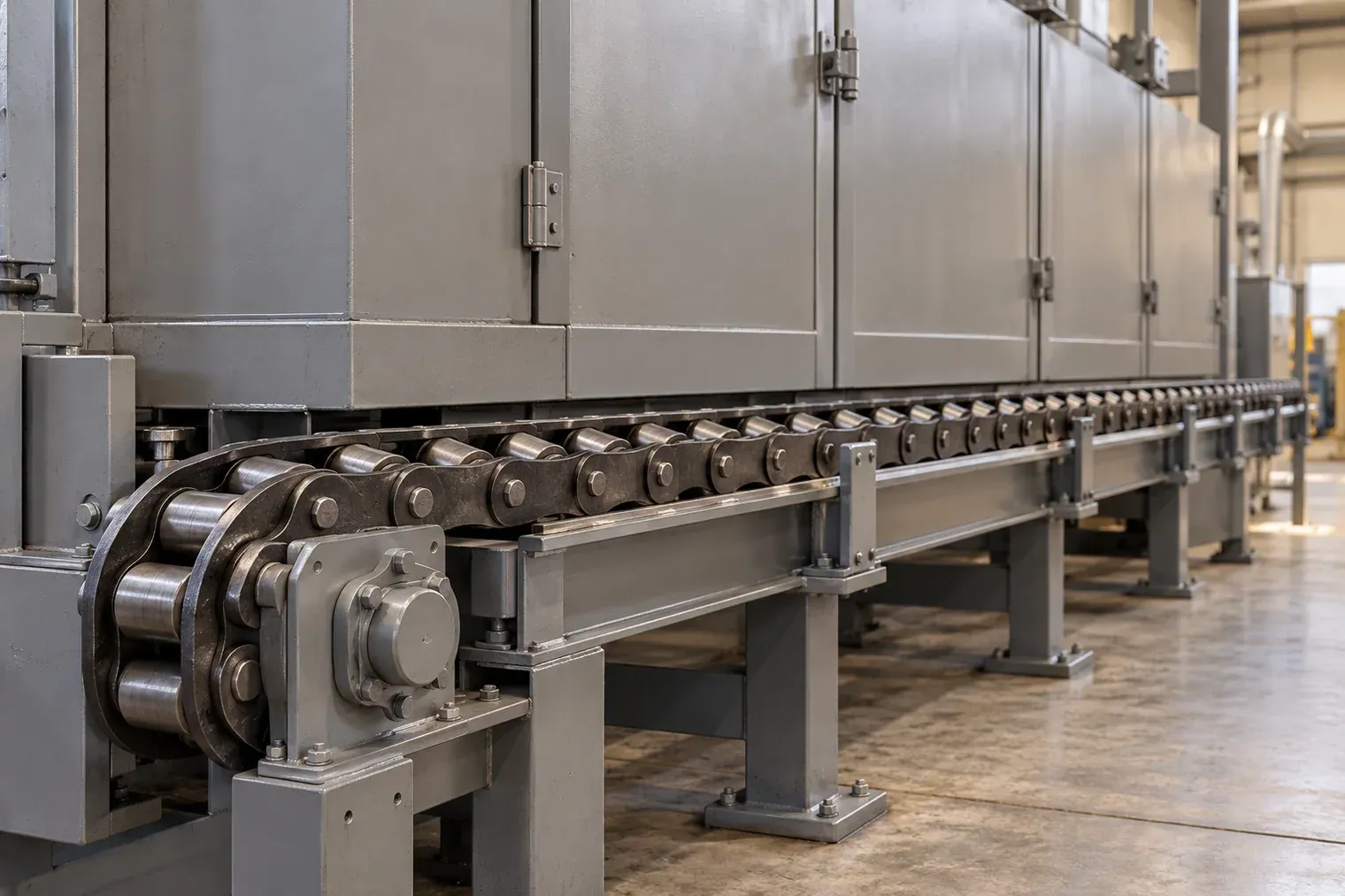
A high-temperature chain oil should be selected for the chain contact and lubrication system, not simply for the temperature printed on an oven or an oil container. A useful first screen separates the measured chain temperature, the oil's documented application envelope and its laboratory properties. These are related pieces of evidence, not interchangeable limits.
The MOSLUBE catalogue includes a high-temperature chain-oil grade named 300°C. That name identifies the offered product; it does not approve every chain installation at that temperature. The practical question is whether the exact grade can reach and lubricate the required contact under a documented, acceptable operating condition.
An oven setpoint is not an oil qualification
An oven setpoint describes the controlled heating process. A chain travels through different locations, and the relevant contact can have a different temperature history. Record where and how the chain temperature was measured, whether the reading represents the required operating load, and whether short peaks differ from sustained exposure. An air reading elsewhere in the oven is not automatically a reading at the loaded contact.
Flash point answers another question. It is a result from a specified laboratory procedure, not a measure of lubricant life or a universal maximum operating temperature. The public significance section of ASTM D92 explicitly limits using its controlled laboratory results alone to appraise end-use fire risk. The method reference on an offered grade must still be checked separately; one open-cup method cannot simply be renamed another.
Do not calculate a safe operating temperature by adding or subtracting an arbitrary margin from flash point. Nor does a high flash point prove acceptable evaporation, residue or wear in a particular chain. Obtain the grade's documented service conditions and the equipment and site assessment before considering an operating trial.
Use the catalogue as a question map
The offered high-temperature chain-oil product lists an open-cup flash-point minimum of 270°C under GB/T 267. Read this as a condition-qualified catalogue statement, not a clearance to run the chain at 270°C or 300°C. Request the current grade documents and applicable test details when specifying acceptance.
| Observed item | What it establishes | What it does not establish | Next evidence |
|---|---|---|---|
| Oven temperature or controller setpoint | A heating-process condition at a defined location | The temperature history of every chain contact | A representative measurement at the relevant chain location and duty |
| The product's 300°C name | Which offered grade is being discussed | A validated continuous service limit for the buyer's installation | The supplier's stated application conditions and equipment/site approval |
| Catalogue open-cup flash point: minimum 270°C, GB/T 267 | A declared laboratory-property limit under the named method | Lubricant life, wear performance or an end-use fire-risk clearance | Current TDS/SDS, method identification and lot acceptance requirements |
| Low reported oil consumption | How much lubricant was supplied during the recorded duty | Adequate penetration or a protective film at the loaded contact | Feed-system checks and the agreed condition/wear observations |
| Visible deposits | A condition requiring investigation and a recorded baseline | Proof that the oil alone caused the problem | Application history, contamination, temperature and comparable residue evidence |
The matrix intentionally leaves operating limits and acceptance thresholds to the documented application. There is no universal temperature, feed rate or relubrication interval that can be derived from these catalogue fields alone.
Check delivery before blaming the oil
A chain can look wet while the required contact receives too little lubricant. First establish the actual lubrication path: where oil is delivered, whether the applicator works consistently, and whether the delivery arrangement follows the equipment and lubricant supplier's instructions. Check access, contamination and feed-system condition during the approved inspection procedure. Do not inspect or adjust an exposed moving or hot chain to obtain a better view.
Keep delivery and thermal behavior as separate questions. Excess oil at an accessible surface does not prove penetration. Increasing the feed can increase consumption or deposits without correcting a poorly positioned or obstructed applicator. Conversely, a dry-looking exposed surface by itself is not a measured wear result. Use the contact and chain-condition checks agreed for that machine.
Evaporation and residue also deserve separate records. Manufacturer guidance for high-temperature chain lubrication discusses both as application considerations. It does not establish that the offered MOS grade has another supplier's performance. A report of low mass loss under one test cannot, by itself, show acceptable deposit character or chain condition under another duty.
Compare a controlled operating window
Only begin a trial after the proposed grade, temperature envelope, application method and changeover procedure have been accepted by the responsible equipment, lubricant and site personnel. If that information is unresolved, the next step is a technical clarification rather than a hotter or longer trial.
Use the current approved lubricant and operating condition as the reference. Record the chain/application point, representative temperature history, load and speed, feed setting, actual lubricant consumption, product batch and inspection interval. Describe the initial chain condition and existing deposits before introducing the candidate. An old dirty chain and a newly cleaned chain are different starting conditions.
Agree in advance what will be observed and what constitutes an unacceptable change. The record can include consumption over the same duty, deposit location and character, lubrication-system behavior and the equipment's appropriate chain-condition or wear checks. Use the site's existing limits and methods; this guide supplies no numeric threshold or guaranteed service interval.
Change one relevant variable at a time where the approved process permits. If grade, feed rate, load and cleaning condition all change together, the result may be useful operationally but cannot isolate the effect of the oil. Record that limitation instead of selecting a winner from an uncontrolled before-and-after photograph.
Turn the result into a grade enquiry
Send the actual application and measurement record with the enquiry for the offered chain-oil grade. State the equipment, lubrication location and system, measured temperature history, duty, current approved lubricant and relevant acceptance requirements. Ask for current grade TDS/SDS, the conditions behind the stated service range, and comparable evaporation/residue or compatibility evidence where needed.
Include sample and order quantities, packaging and destination after the technical basis is clear. If incidental food contact, a specific approval or another compliance claim is required, request verifiable evidence for that exact grade; none is established by the generic chain-oil name. The purchasing decision should connect a real supplied grade to a documented contact and acceptable qualification record, rather than to a temperature label alone.