



GL4 vs GL5 Gear Oil: Confirm the Application Before Switching
The higher GL number is not a universal upgrade. Separate service category, viscosity and OEM compatibility before buying replacement gear oil.
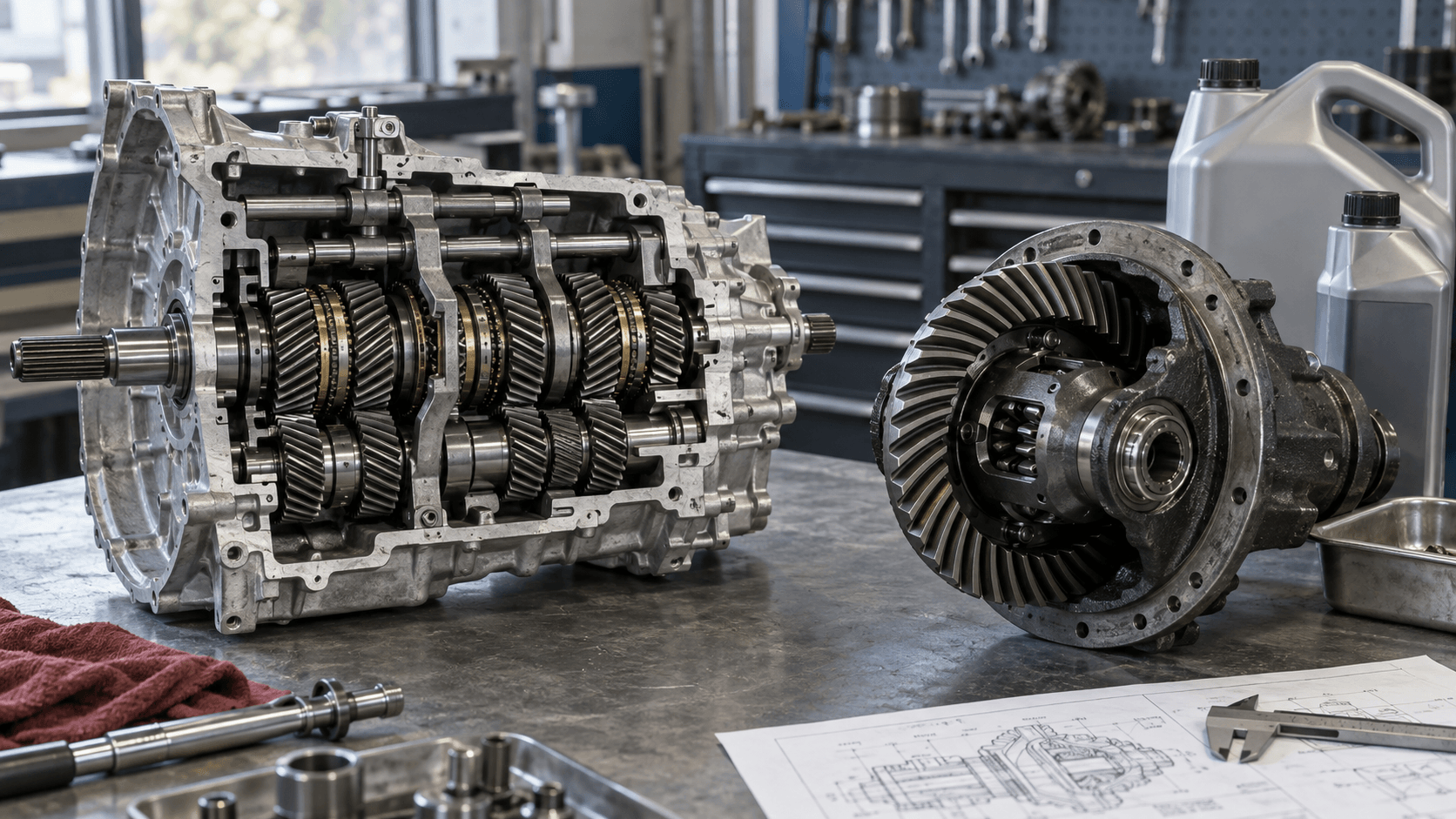
A GL-5 label does not automatically make an oil a suitable replacement for a GL-4 requirement. Identify the exact transmission or axle and obtain its manufacturer’s lubricant specification first. Then compare the service designation, SAE viscosity grade and evidence for the proposed product. MOS lists GL-4/GL-5 gear-oil options; this comparison helps a technical buyer qualify an enquiry, rather than approve an interchange from the label alone.
What the GL number can—and cannot—tell the buyer
API 1560, ninth edition (November 2023), describes GL-5 primarily for hypoid axle service. It lists GL-4 among designations not in current use for performance verification, while noting continued commercial use and recommending supporting documentation for previously tested lubricants. This does not tell a buyer to replace every GL-4 requirement with GL-5. SAE viscosity is a separate classification. Limited-slip axles have additional friction requirements specified by the axle manufacturer. Neither category alone proves suitability for a particular synchronised transmission.
| Purchasing check | Evidence to request | Reason it changes the decision |
|---|---|---|
| Exact unit | Transmission or axle model and OEM lubricant requirement | A gearbox request is not automatically an axle-fluid request |
| Service and viscosity | Required API designation and SAE grade, stated separately | A different viscosity is another change, not evidence of category superiority |
| Synchronised transmission | Product-specific friction/material compatibility and OEM acceptance | A metal-corrosion result alone does not establish shifting behavior |
| Limited-slip differential | The axle’s friction requirements and offered-product evidence | GL-5 alone does not establish limited-slip suitability |
| Supporting documents | Current offered-product TDS/SDS, specification and relevant test evidence | A family page or category claim is not an OEM approval |
The two catalogue examples change more than one variable
The GL-4 80W-90 option and GL-5 75W-90 option differ in both service designation and viscosity label. A change in shifting, noise or operation after swapping those products cannot be attributed to GL category alone. Use the OEM-approved viscosity and an agreed evaluation method. Where available, compare candidates on the same viscosity basis before investigating a service-category change. Do not treat either catalogue listing as a transmission-specific approval.
Avoid two blanket shortcuts: “all GL-5 replaces GL-4” and “all GL-5 attacks yellow metals.” Formulations and equipment requirements differ. Ask for evidence tied to the exact proposed product. Material compatibility, synchronizer friction and an OEM’s accepted lubricant specification are separate checks; a positive answer to one does not answer the others.
Qualify a replacement before a fleet rollout
Do not put an unqualified oil into service simply to test a comparison. First obtain the equipment owner’s technical acceptance and supplier confirmation. Any approved evaluation should retain a record of the existing oil, unit condition, service interval, temperature/load and evaluation criteria. Keep other changes identifiable. A single satisfactory drain inspection does not establish a universal replacement or a longer service life.
Send the gearbox or axle requirement with the RFQ
Start at the gear-oil Product page and specify the exact unit, OEM specification, current oil, required service designation and viscosity, operating conditions and document requirements. Include order quantity, annual demand, packaging and destination. Request the offered-grade TDS/SDS, relevant supporting test/compatibility documentation and a sample only with an agreed evaluation plan. If the request concerns a GL-4 transmission option or GL-5 axle candidate, identify that application explicitly; availability and suitability require supplier confirmation.
Gear-oil procurement FAQ
Does GL-5 always replace GL-4?
No. Follow the exact equipment requirement and confirm the proposed formulation’s application compatibility; a higher category number is not a universal upgrade.
Is GL-4 an API-certified claim?
Do not infer certification from the wording. API1560 lists GL-4 as not in current use for performance verification but commercially used; request relevant supporting documentation and the offered-product specification.
Can a corrosion test confirm synchronizer suitability?
Not by itself. Material compatibility and synchronizer friction/shifting requirements are distinct; obtain application-specific evidence.
Can GL-4 80W-90 and GL-5 75W-90 isolate the GL difference?
No. That comparison changes viscosity as well as service category. Record both and follow the OEM specification before evaluation.